
Many labs choose multilayer zirconia blocks for a simple reason: the material can save staining time and give the crown a smoother cervical-to-incisal transition. But in daily CAD/CAM production, the material name does not guarantee the result.
Even when the shade is selected correctly, a crown may still look too light after sintering. For a bridge, nesting it higher in the disc may improve the visual effect, but it can reduce the strength margin around the connectors. This is why multilayer zirconia should not be judged only by shade or translucency.
For dental labs, the real question is whether the shade gradient, nesting position, and strength range match the case.
What Multilayer Zirconia Actually Changes in Lab Production
Multilayer zirconia is zirconia material with a gradual transition inside the block or disc. Depending on the material formulation, this transition may include shade, translucency, and sometimes strength distribution. [1,2]
For a dental lab, this means the restoration is not milled from one uniform shade zone. The cervical, body, and incisal zones of the disc all influence how the restoration looks after sintering.
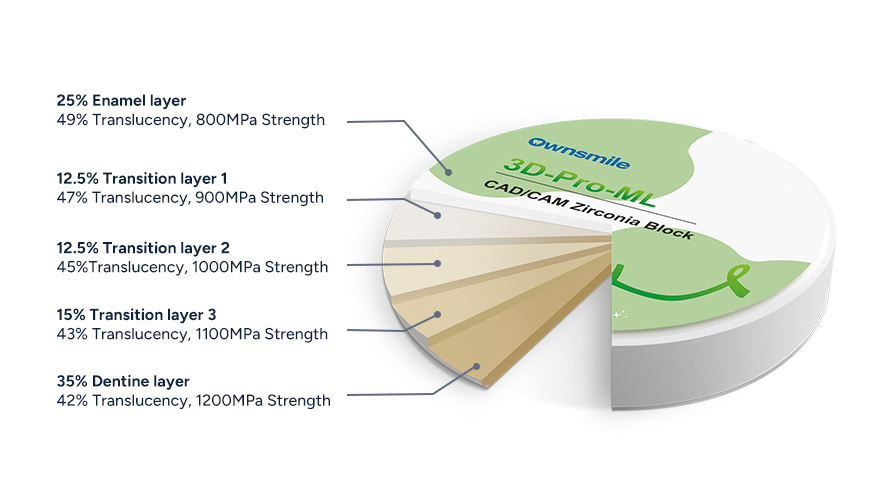
When the case is nested well, this gradient can reduce staining work and create a smoother cervical-to-incisal transition. When it is nested poorly, the same material can produce a crown that looks too light, too chromatic, or uneven.
For example, when a crown is nested too high, the cervical chroma may become weaker. When it is nested too low, the incisal area may look heavier. If a bridge is tilted across the disc, the final shade may look uneven from one unit to another.
Monolithic zirconia means the crown or bridge is milled as a full-contour structure, without porcelain layering. A multilayer zirconia block can be used for monolithic restorations, layered restorations, or partially layered cases.
So when a lab says "monolithic multilayer zirconia," it usually means a full-contour restoration milled from a multilayer disc. The restoration is monolithic in design, while the material has an internal gradient.
Why Multilayer Zirconia Can Look Too Light or Uneven After Sintering
Choosing the correct shade does not always guarantee the expected result after sintering.
In many multilayer zirconia systems, the cervical, body, and incisal areas are designed to create different shade and translucency effects. The final appearance therefore depends not only on the shade printed on the disc, but also on how the restoration passes through these zones.
This is why two restorations milled from the same shade disc can still look different.
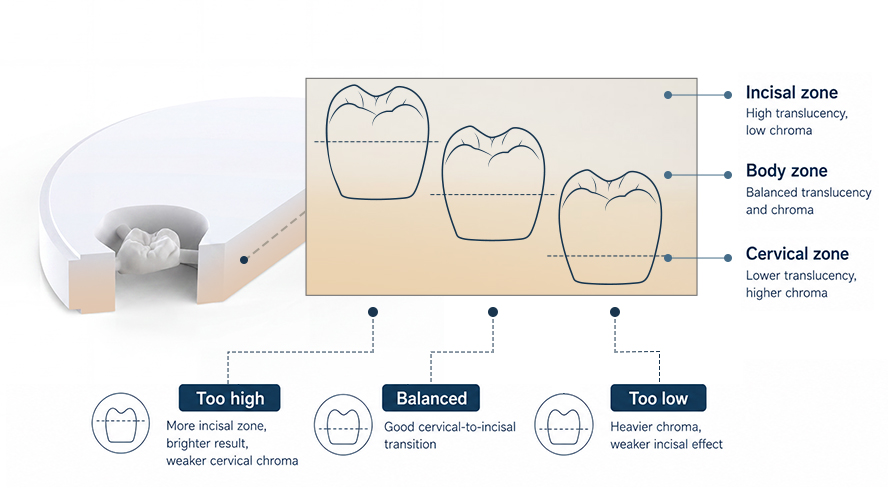
Restoration height and vertical nesting position are common reasons. A short crown may capture only part of the gradient, while a taller restoration can pass through more shade zones. Bridges are even more sensitive because several units need to move through the gradient in a balanced way. [3]
Nesting is not the only factor. The sintering program, coloring or staining steps, glazing, surface finishing, and restoration thickness can also influence the final appearance.
So when a restoration looks too light, too chromatic, or uneven, the material itself should not be the first and only suspect. The lab should look at the complete shade workflow, starting with nesting position.
How Nesting Position Affects Multilayer Zirconia Shade
Nesting determines which parts of the internal gradient become visible in the final restoration.
For a single crown, the operator should first compare the restoration height with the available gradient inside the disc. A crown placed higher in the gradient may appear brighter and more translucent, while a lower position may create stronger cervical chroma. [4]
The ideal position depends on the case. An anterior crown may need more attention to the incisal transition, while a posterior crown may need a different balance between body shade and translucency.
Bridges need more careful planning. All units should pass through the gradient as evenly as the design allows. Excessive tilting only to improve the appearance of one area can make the shade transition less consistent across the bridge.
For bridges, shade position should not override connector design, strength requirements, or the material indication.
- Restoration height relative to disc thickness
- Cervical and incisal zone position
- Gradient balance across bridge units
- Connector height and wall thickness
- Support requirements for larger restorations
For production labs, clear nesting rules are usually more reliable than relying on each operator's personal habit. Anterior crowns, posterior crowns, and bridges do not always need the same nesting approach.
Strength and Translucency: Where Labs Should Be Careful
Multilayer zirconia should not be selected by translucency alone. A high translucency number may look attractive on a product sheet, but it does not tell the lab whether the material is safe for a bridge.
For thin anterior crowns, shade position and translucency are important. The restoration needs enough brightness and depth without looking too flat or too heavy. In these cases, the material gradient and nesting position can make a visible difference.
For posterior bridges, the decision is different. Connector space, span length, occlusal clearance, and strength range matter more than incisal translucency. A more translucent zone may improve the visual result, but it may not provide the best safety margin. [2]
This is where many labs need to slow down. A bridge that looks better on the screen is not always the safer bridge after milling and sintering. A multilayer zirconia crown and a multilayer zirconia bridge may come from the same product line, but they should not be treated as the same type of case.
For crowns, the material is often more forgiving. For bridges, especially posterior bridges, the connector area is where the decision becomes stricter.
If the case has a long span, limited connector height, bruxism risk, or heavy posterior load, high-strength zirconia may be safer than a material selected mainly for translucency.
Best Applications and Caution Cases
Multilayer zirconia works best when the shade gradient, strength range, and restoration design fit the case. It is not the best answer for every restoration.
| Case Type | Suitability | Lab Notes |
|---|---|---|
| Anterior crowns | Highly suitable | Vertical nesting strongly affects incisal transition. Thin crowns need careful shade positioning. |
| Posterior crowns | Suitable | Body shade and occlusal thickness matter more than incisal translucency. Check minimum thickness after adjustment. |
| Full-contour restorations | Suitable | Useful when little or no porcelain layering is planned. Finishing and staining may still be needed. |
| Short-span bridges | Suitable when indicated | Follow connector dimensions, wall thickness, and sintering support requirements. Avoid over-prioritizing translucency. |
| Long-span bridges | Use caution | High-strength zirconia may be safer, especially when connector height is limited or span length is extended. |
| Bruxism or high-load cases | Use caution | Strength margin, occlusal thickness, and connector design should come before shade transition. |
| Implant-supported crowns | Suitable when design allows | Check screw-channel design, restoration thickness, occlusal clearance, and bonding or cementation requirements. |
For routine crowns and selected bridges, this type of zirconia can reduce staining workload because the base shade transition comes from the disc structure. It does not remove the need for finishing. Final shade adjustment, texture, glaze, and characterization may still be needed.
How Multilayer Zirconia Differs from White and Pre-Shaded Zirconia
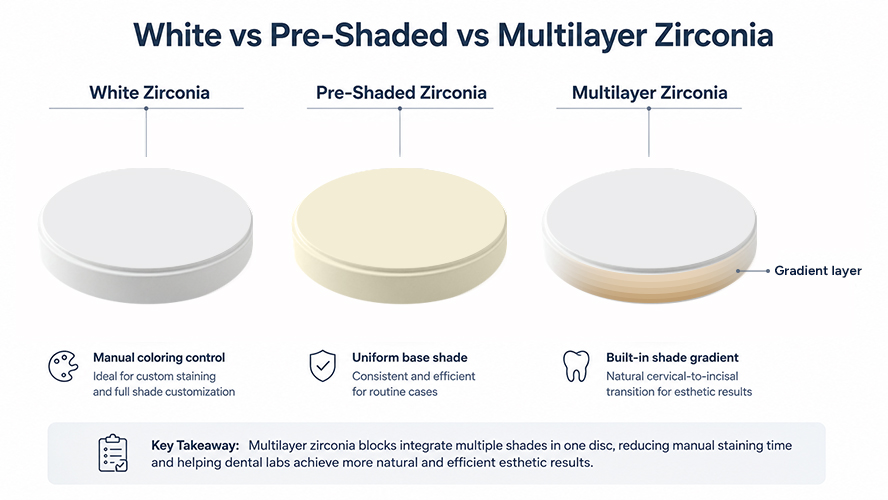
White zirconia, pre-shaded zirconia, and multilayer zirconia all have their place in lab production. Each material solves a different lab problem. The better choice depends on how much manual shade control the lab wants, how many routine cases need to be produced, and how much gradient effect the restoration requires.
| Material Type | Main Advantage | Main Limitation | Suitable Lab Use |
|---|---|---|---|
| White zirconia | Highest freedom for external coloring | More staining time and stronger technician control required | Customized shade cases and labs with strong staining protocols |
| Pre-shaded zirconia | Faster routine base shade control | Usually less cervical-to-incisal transition than multilayer discs | Routine crowns and cases needing stable base shade |
| Multilayer zirconia | Controlled shade gradient through the disc | Requires correct nesting position and case selection | Crowns, selected bridges, and full-contour restorations with reduced staining workload |
White zirconia gives the technician more freedom. Pre-shaded zirconia simplifies base shade selection. Multilayer zirconia provides a controlled shade gradient for cases that benefit from a smoother cervical-to-incisal transition.
A practical zirconia inventory usually includes more than one material type, so labs can match the disc to the case instead of forcing every restoration into the same material.
Ownsmile Multilayer Zirconia Selection Reference
In daily lab production, one multilayer zirconia disc cannot cover every case equally well. When labs compare zirconia blocks for daily production, strength range, translucency, and common case use should be considered together. Ownsmile multilayer zirconia options can then be used as a practical reference, not only a shade list.
| Product | Translucency / Strength | Lab Use Reference |
|---|---|---|
| 3D Pro Multilayer Zirconia | 43-49% translucency, 800-1200 MPa | Routine crowns, selected bridges, and full-contour daily cases |
| ST Multilayer Zirconia | 42% translucency, 1100-1200 MPa | Posterior crowns and bridge cases where strength margin is more important |
| SHT Multilayer Zirconia | 42-46% translucency, 900-1100 MPa | Crowns and selected bridges needing a balance of strength and translucency |
| UT Multilayer Zirconia | 57-60% translucency, 600-800 MPa | Anterior and esthetic cases where translucency is prioritized |
For high-load, long-span, or complex bridge cases, labs should always check the material indication, connector design, minimum thickness, and sintering support before milling.
FAQ
Multilayer zirconia is zirconia material with an internal gradient. The gradient may include shade, translucency, and sometimes strength distribution.
They are used for crowns, selected bridges, full-contour restorations, and suitable implant-supported crowns. Indications depend on material strength, design, connector dimensions, and manufacturer guidance.
No. Monolithic zirconia describes a full-contour restoration design. Multilayer zirconia describes the material structure. A multilayer disc can be used to mill monolithic restorations.
Nesting controls how the cervical, body, and incisal zones appear in the final restoration. Poor vertical positioning can cause weak chroma, reduced incisal effect, or uneven shade across bridge units.
Pre-shaded zirconia provides a stable base shade through the disc, but usually has less cervical-to-incisal transition. Multilayer zirconia has an internal gradient, so the final shade effect depends more on vertical nesting position and restoration height.
Conclusion
Multilayer zirconia is not just a more esthetic zirconia block. It works well only when the gradient, nesting position, strength range, and restoration design match the case.
For anterior crowns, vertical position can change the final shade. For posterior bridges, connector design and strength margin often matter more than translucency. The best results come when the disc is selected together with the CAD design, case type, and sintering plan.
References
[1] Kolakarnprasert N, Kaizer MR, Kim DK, Zhang Y. New multi-layered zirconias: Composition, microstructure and translucency. Dental Materials. 2019;35(5):797-806.
[2] Inokoshi M, Liu H, Yoshihara K, et al. Layer characteristics in strength-gradient multilayered yttria-stabilized zirconia. Dental Materials. 2023;39(4):430-441.
[3] Pongtongkham P, Pleumsamran N, Suttiat K. Effect of CAD/CAM position and thickness of ultra-translucent multilayered zirconia on color aspects. International Journal of Dentistry. 2023;2023:5000800.
[4] Kuraray Noritake Dental Inc. KATANA™ Zirconia Technical Guide.