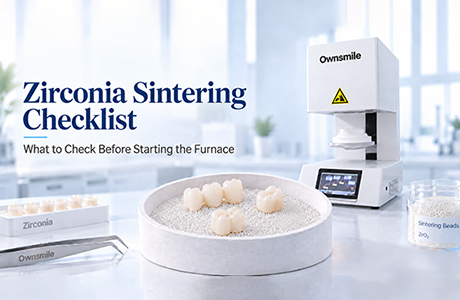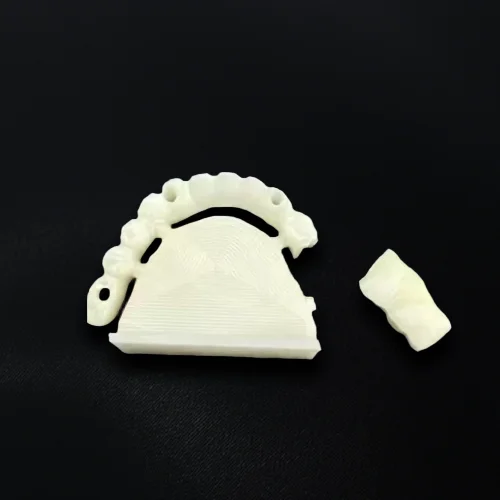

Fast sintering looks simple on paper. It shortens the firing cycle, helps with urgent cases, and gives dental labs more flexibility between milling and finishing.
But in daily lab work, the question is rarely just: “Is fast sintering faster?”
- Will the zirconia remain strong after a shorter cycle?
- Will the shade stay consistent?
- Can a bridge safely go through a fast program?
- Does a faster cycle increase the risk of cracks or distortion?
- And when is conventional sintering still the safer choice?
Let’s break down the practical differences between fast and conventional zirconia sintering, and how labs can choose the safer cycle for each case.
What Is Conventional Zirconia Sintering?
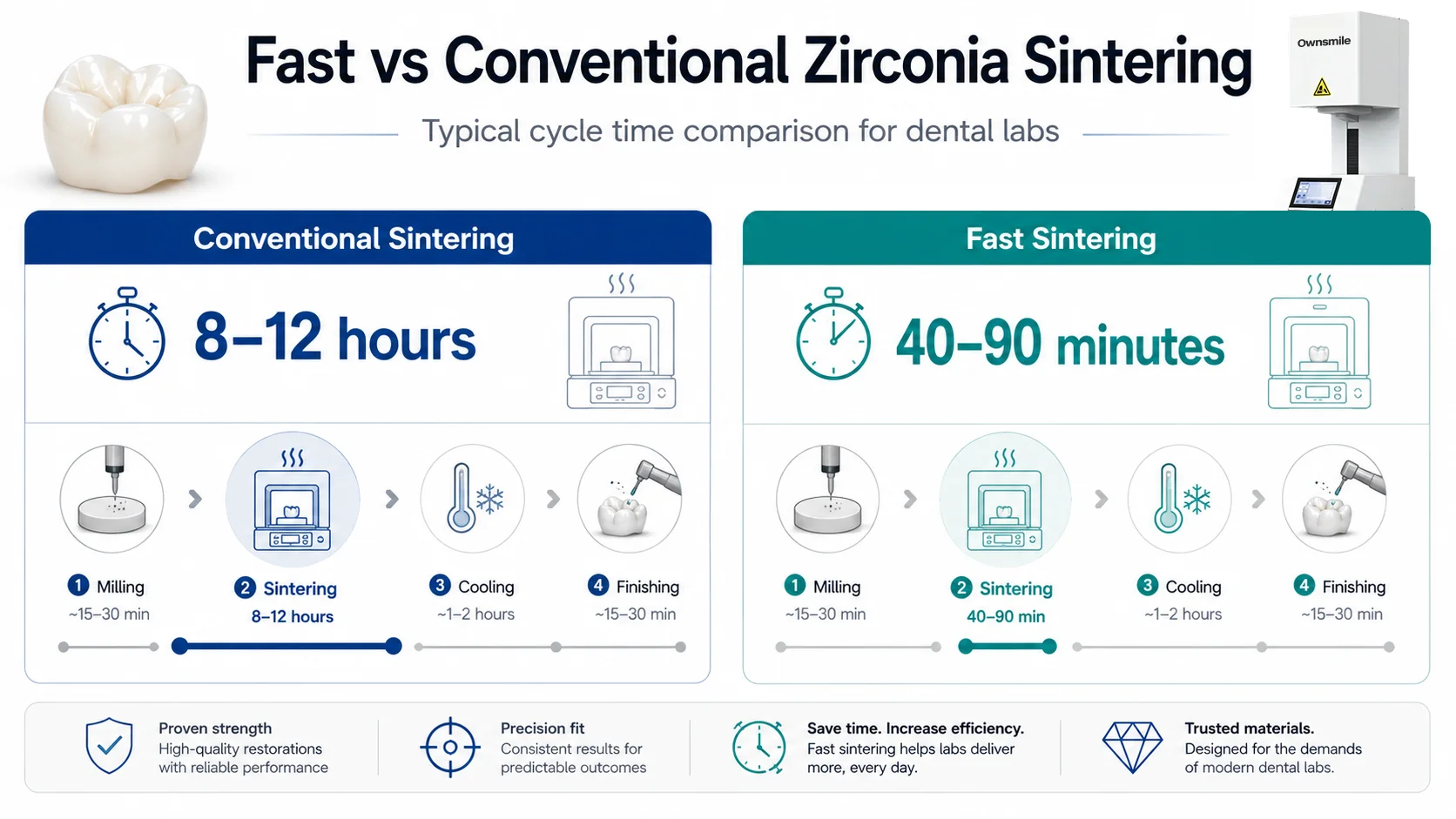
Conventional zirconia sintering usually runs for around 8–12 hours in many dental lab workflows. It uses slower heating, a longer holding stage, and controlled cooling to give the restoration more time to shrink and densify during firing.
This gradual cycle gives the lab a wider process margin, especially when the restoration has thicker areas, pontics, connectors, or uneven wall thickness. For bridge cases, multilayer zirconia, strict shade-matching work, or restorations that are difficult to remake, conventional sintering often remains the safer default.
What Is Fast Sintering for Dental Zirconia?
Fast sintering usually takes around 40–90 minutes. It shortens the firing cycle by using a higher heating rate and a shorter holding stage.
When the zirconia material, restoration design, and furnace program are suitable, the restoration can still reach the required sintering temperature and densification level within a shorter production window.
Fast Sintering vs Conventional Sintering: Main Differences
Speed matters, but it is not the only variable. Heating rate, holding time, peak temperature, zirconia type, restoration design, and furnace program all affect how much process margin a lab has.
Below is a practical comparison:
| Factor | Conventional Sintering | Fast Sintering |
|---|---|---|
| Typical cycle time | 8–12 hours | 40–90 minutes |
| Heating rate | Around 5–10°C/min | About 35–200°C/min, depending on the furnace and program |
| Peak temperature | Around 1450–1550°C | Around 1450–1600°C |
| Holding time | Often 1–2 hours | 0–30 minutes |
| Best suited for | Bridges, thick restorations, multilayer cases, strict shade cases | Simple monolithic crowns, urgent single-unit cases, and routine posterior crowns with sufficient thickness and a validated program |
| Main advantage | Wider process margin and stable results | Shorter turnaround time |
| Main concern | Longer production time | Lower margin for error if material or case is not suitable |
Fast sintering does not automatically mean poor results, but it also should not be treated as identical to conventional sintering. Results depend on whether the material system, case geometry, and firing schedule are suitable for the shorter cycle.
Does Fast Sintering Make Zirconia Weaker?
Many labs ask this question first because strength is still the baseline requirement for zirconia restorations.
Fast sintering does not automatically make zirconia weaker. Mechanical strength depends on several factors, including zirconia type, sintering temperature, holding time, grain growth, restoration thickness, milling quality, surface finishing, and cooling behavior.
Published reviews do not support a simple conclusion that faster sintering automatically weakens zirconia. Results vary by zirconia type, sintering protocol, furnace system, and the property being measured, including mechanical, optical, and precision-related outcomes[1],[2]. Aging data also support this cautious view. Jerman et al. reported that high-speed sintering did not necessarily reduce flexural strength after hydrothermal and thermo-mechanical aging under tested in-vitro conditions[3].
However, these findings should not be treated as approval for every zirconia block or every restoration design. Zirconia generation, coloring method, furnace system, and restoration geometry all matter.
For daily production, fast sintering is usually more reasonable for simple monolithic restorations with a validated material and furnace program. Multilayer zirconia, high-translucency zirconia, thick restorations, long-span bridges, uneven wall thickness, or new materials should be handled more carefully.
A better question is not only, "Does fast sintering reduce strength?" A more practical question is: "Is this zirconia material, restoration design, and furnace program approved for this faster cycle?"
Does Fast Sintering Affect Zirconia Shade or Translucency?
Shade is another major concern, especially for anterior restorations, multilayer zirconia, and cases where small value differences are easy to notice.
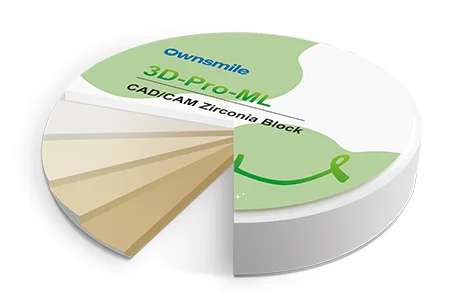
Fast sintering may affect the final appearance depending on the material and program. Zirconia shade and translucency can be influenced by sintering temperature, holding time, material formulation, translucency level, coloring method, restoration thickness, cooling behavior, and surface finishing.
Optical results are often more material-sensitive than strength outcomes. For example, a 2023 study on multilayered 5Y-zirconia found that high-speed sintering slightly lowered translucency in most layers, with different effects depending on the zirconia product and layer structure[4]. This is why shade and translucency should be checked by material and cycle, not assumed from general fast-sintering data.
For shade-sensitive work, labs can compare a fast-sintered sample with a conventionally sintered sample from the same zirconia material and shade. Keep thickness, surface finishing, lighting, background, and camera settings consistent. Do not compare one sample under a bench LED and another near a window, because lighting differences can easily be mistaken for sintering differences.
Can Fast Sintering Cause Cracks After Sintering?
Fast sintering is rarely the only reason a zirconia restoration cracks. More often, it reduces the safety margin of the workflow.
If the restoration already has uneven wall thickness, bulky pontics, large connectors, milling stress, poor sintering support, or uncontrolled cooling, a faster cycle may expose those weak points more clearly.
In other words, fast sintering should be understood as a lower-margin process, not a single-cause explanation for every crack. For thick restorations, long-span bridges, or cases with uneven geometry, conventional sintering usually gives the lab more process stability.
For a deeper troubleshooting workflow, see our guide on why zirconia cracks after sintering.
Which Zirconia Cases Are Better for Fast Sintering?
Fast sintering is usually more suitable for simpler zirconia cases, especially when the zirconia material and furnace program allow a shorter cycle.
Not every zirconia block should be treated as suitable for fast sintering. Some materials are mainly designed for conventional sintering cycles, while selected zirconia systems may support faster programs for approved indications. Before using a shorter cycle, labs should check whether the zirconia block, restoration type, and furnace schedule are compatible.
For material selection, compare zirconia blocks by strength, translucency, indication, and sintering workflow.
Fast sintering approval is usually indication-specific. For example, KATANA’s sintering schedule allows 90-minute sintering for approved 3-unit bridge cases, while 4-unit bridges or larger cases require the general sintering program[5]. This is a useful reminder that bridge indication should be checked by material system, not by span length alone.
In daily lab work, the better question is not only "Can this case be fast sintered?" but "Is this material system and case design actually approved for the faster cycle?"
When Conventional Sintering Is Still Safer
Conventional sintering still has an important place in dental lab production. It is usually the safer choice when the case has higher risk, higher value, or less tolerance for error.
Labs may prefer a conventional cycle for long-span bridges, thick restorations, multilayer zirconia, strict shade-matching cases, new zirconia materials, or restorations that are difficult to remake. A slower cycle gives the restoration more time to shrink, densify, and stabilize under controlled thermal conditions.
Fast sintering can improve turnaround time when the case is suitable. Conventional sintering remains important when process stability matters more than speed.
FAQ
No. Fast sintering is not automatically bad for zirconia. For suitable monolithic cases, it can shorten turnaround time without necessarily reducing performance. The risk increases when the lab uses a fast program without checking the zirconia material, indication, thickness, or furnace schedule.
Not necessarily. Studies show that speed sintering does not always reduce zirconia’s main mechanical properties when the material and program are properly matched. However, crowns, bridges, thick restorations, and high-translucency zirconia should not all be treated the same.
It can. Shade and translucency are often more sensitive to sintering changes than strength. Final appearance may vary with zirconia formulation, translucency level, thickness, coloring method, temperature, holding time, and surface finishing.
Some zirconia bridges may be suitable for fast sintering, but only when the material system and furnace schedule allow it. Long-span bridges, bulky connectors, implant-supported bridges, or cases with strict fit requirements are usually safer with conventional sintering.
Usually, no. Fast sintering is better used as an additional workflow option for suitable urgent or single-unit cases. Conventional sintering still gives labs a wider safety margin for bridges, thick restorations, multilayer zirconia, and high-esthetic cases.
Conclusion
Fast sintering can help dental labs shorten turnaround time for suitable monolithic zirconia cases, but it should not be treated as a universal shortcut. The result still depends on the zirconia material, restoration design, and furnace program.
Conventional sintering remains the safer choice for bridges, thick restorations, multilayer zirconia, and high-esthetic cases where process stability matters more than speed.
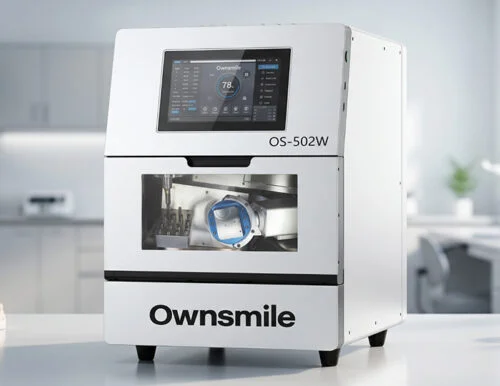
For daily production, labs need flexibility rather than one fixed cycle. A dental sintering furnace that supports both fast and conventional programs allows technicians to use faster cycles for suitable urgent cases, while keeping a wider safety margin for complex restorations.
References
- Al-Haj Husain N, et al. Conventional, Speed Sintering and High-Speed Sintering of Zirconia: A Systematic Review. Journal of Clinical Medicine. 2022;11(16):4892. doi:10.3390/jcm11164892.
- Liu H, et al. Does speed-sintering affect the optical and mechanical properties of yttria-stabilized zirconia? Japanese Dental Science Review. 2023;59:312–328. doi:10.1016/j.jdsr.2023.08.007.
- Jerman E, et al. Effect of high-speed sintering on the flexural strength of aged zirconia materials. Dental Materials. 2020;36(9):1144–1150. doi:10.1016/j.dental.2020.05.013.
- Cho M-H, Seol H-J. Effect of High-Speed Sintering on the Optical Properties of Multilayered 5Y-Zirconia. Materials. 2023;16(16):5570. doi:10.3390/ma16165570.
- Kuraray Noritake Dental. KATANA Zirconia Materials: Sintering Schedule. Accessed May 2026.