Dental Knowledge
-

English
-

Spanish
English
Spanish
In today’s fast-moving dental industry, precision, efficiency, and adaptability are no longer optional. They are essential. Whether you manage a busy dental lab or oversee product lines as a dealer, understanding how dental milling machines work and knowing how to choose the right one can reshape workflows and boost client satisfaction. This guide breaks it all down for you.

A dental milling machine is a high-precision system that shapes restorations from solid blocks of material. It creates crowns, bridges, inlays, and implant components based on digital designs. It works as part of the digital workflow, transforming a CAD design into a finished restoration, including intricate restorations, with micrometer-level accuracy.
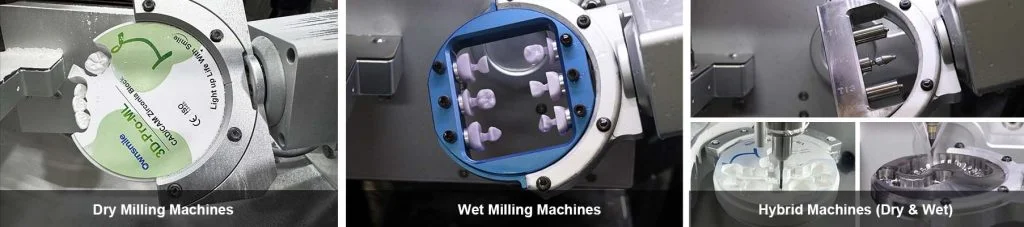
Dental milling machines typically fall into three categories:
A dry mill operates without liquid coolant and is optimized for speed and efficiency, especially for materials like zirconia. Dry processing is a key feature for high-performance milling of blocks and discs, using compressed air or pressurized air to keep the work area clean and ensure efficient operation.
Required for materials like lithium disilicate, titanium, which demand continuous coolant to prevent microfractures or overheating. Wet grinding is essential for certain materials, such as titanium abutments, to ensure full efficiency.
Support both dry and wet processing modes, offering flexibility for different materials and enabling seamless switching between materials.
Dry and wet milling processes in one machine, allowing dental professionals to select the optimal technique for each case.
Modern dental milling machines support a wide range of materials. The options you need depend on your case types, esthetic goals, and the kind of restorations you deliver most often.

Zirconia Block: Strong and aesthetic, for crowns, bridges, and full arches.
PMMA: For temporaries and long-term provisionals.
Wax: For temporary restorations, diagnostic wax-ups, and casting patterns.
PEEK: Biocompatible high-performance polymer, widely used for frameworks, temporary restorations, and implant-supported structures.
Glass Ceramics (lithium disilicate): Excellent translucency for anterior restorations (usually wet milled).
Premill: For custom implant abutments. Requires compatible holders and is usually milled using specialized strategies.
Titanium disc: for custom abutments, implant bars, partial frameworks, and Maryland bridges.
Co-Cr: Highly durable and corrosion resistant, cobalt-chrome alloys are used for partial denture frameworks, porcelain-fused-to-metal (PFM) crowns and bridges and certain implant bars.
If your machine can mill multiple materials, you have more options for your lab and your clients. Some dental milling and grinding machines are designed for high volume production, so are ideal for large laboratory environments that require continuous output.
Not all milling machines are built the same. Here are the features labs and dealers should prioritize, including advanced features that enhance performance and workflow:
Choosing the right dental milling machine isn’t just about technical features. It’s about finding the best fit for your lab’s workflow, materials, and budget. Price is a major consideration. At the same time, it’s equally important to consider the level of support, software compatibility, and whether the system can scale with your lab over time.
Dental milling machines span a wide price range, largely depending on their type, performance, and automation level. Here’s a reference for mainstream and high-end pricing:
Machine Type | Mainstream Price | High-End Price | Example Brands / Models |
|---|---|---|---|
Dry Milling | $8,000–$15,000 | $35,000–$55,000+ | Shining3D DS series, Aidite AG series, imes-icore CORiTEC 350i Dry, Zirkonzahn M1, Roland DWX-52D, vhf K5+ |
Wet Milling | $12,000–$20,000 | $38,000–$70,000+ | Aidite AMW-400, Shining3D Aegis series, vhf E3, Roland DWX-4W, imes-icore 350i PRO Wet, vhf R5, Zirkonzahn M2 Wet |
Hybrid (Dry & Wet) | $18,000–$28,000 | $50,000–$80,000+ | Shining3D Aegis HM, Aidite AMX-4 Hybrid, Roland DWX-52D (with wet kit), vhf K5+ Hybrid, imes-icore 350i PRO+/450i, Zirkonzahn M4 |
If you require flexibility for multiple materials, consider a hybrid model that supports both wet and dry processes.
A good milling machine isn’t just defined by its features—it’s also about the support behind it. Reliable after-sales service is essential for minimizing downtime and keeping production on schedule. Labs should look for suppliers that offer fast-response technical support, practical training resources, and remote troubleshooting when needed. With strong support and consistent training, teams can resolve issues faster, stay productive, and get more value from their investment.
Like any precision instrument, a dental milling machine needs regular care to perform at its best.
Whether you're scaling your lab’s digital capabilities or selecting a reliable solution for your product portfolio, choosing the right milling machine is a decision that pays long-term dividends.
Explore our products to compare machines and configurations, or contact us for tailored guidance based on your lab’s needs.
 Dental Knowledge
 Dental Knowledge
 Dental Knowledge